Smart ERP for Schools, Colleges & Universities

How Schools Can Support Student Mental Health and Holistic Development

 

Student Mental Health & Holistic Development | How Schools Can Nurture Emotional Well-being

Learn how schools can strengthen student mental health and promote holistic development through awareness, empathy, and technology-led support. Practical steps every educator should know.

“Children are not things to be molded, but people to be unfolded.” – Jess Lair

That line says it all.

In today’s fast-moving world of marks, exams, and achievements, schools are quietly facing a deeper challenge — student mental health.

A few decades ago, emotional well-being wasn’t even a topic in school discussions. Today, it’s a national concern.

According to a 2024 UNICEF report, nearly 1 in 7 Indian adolescents struggles with mental health issues. Anxiety, stress, and burnout have crept into classrooms silently — sometimes unnoticed until it’s too late.

But here’s the truth: schools can make the difference.
Not by doing something extraordinary — but by changing how we see and support our students.


What Does “Holistic Development” Really Mean?

Holistic development is not just about grades or skills. It’s about growing a balanced human being — emotionally, mentally, socially, and physically.

It includes:

  • Emotional health — learning to manage feelings

  • Social growth — building confidence and empathy

  • Physical health — staying active and energized

  • Intellectual curiosity — learning beyond exams

  • Moral and spiritual values — forming identity and purpose

In short, it’s teaching students not just how to make a living — but how to live.


The Hidden Crisis in Indian Schools

Some numbers may surprise you:

  • 73% of Indian students (age 13–18) reported feeling “anxious about academics.”

  • 42% said they experience stress before exams every month.

  • Only 19% of schools in India have an active counselor or psychologist.

  • 80% of teachers say they lack training to handle emotional issues in class.

That’s the unseen gap. Schools often focus on results, not resilience.

“We are preparing children for exams, but not for life.”

It’s time to change that story.


? Why Mental Health Should Be a School’s Core Priority

1. Because Learning Starts with Feeling Safe

A student who feels emotionally secure learns better.
If a child is anxious or fearful, no amount of teaching will truly reach them.

2. Because Academic Stress Is Real

In India, exam pressure is the No.1 cause of student anxiety.
Automation and structured academic planning (through systems like MyLeading Campus®) can help teachers reduce last-minute chaos and deadlines — one silent cause of stress.

3. Because Emotional Intelligence Is the Future Skill

The world is moving towards empathy-driven leadership.
When students learn to manage emotions, work in teams, and show compassion — they gain the foundation for real success.


How Schools Can Actively Support Mental Health

Step 1: Start with Awareness

Create open conversations. Conduct mental health sessions not as “lectures,” but as safe spaces where students can share freely.

Use simple formats like:

  • Circle-time discussions

  • Peer-support groups

  • Anonymous question boxes

“Sometimes, just letting a child talk is the first step toward healing.”


Step 2: Train Your Teachers

Teachers are often the first to notice when something’s off — a quiet student, a sudden change in grades, or isolation from peers.

But most teachers are not trained counselors.
Schools can conduct basic emotional intelligence and mental health workshops to help staff recognize early warning signs.

Through MyLeading Campus® HR & Training Module, schools can even schedule and track such workshops easily.


Step 3: Build a Student Support System

Appoint a mental health counselor — even part-time — or collaborate with NGOs that specialize in adolescent wellness.

Encourage:

  • Monthly counseling sessions

  • Life-skills clubs

  • Peer mentoring programs

Students often open up better to peers before adults — structured peer mentoring can bridge that gap.


Step 4: Reduce Academic Overload with Smart Planning

A lot of stress in schools comes from poor scheduling — overlapping exams, last-minute announcements, heavy homework.

ERP automation tools like MyLeading Campus® help create balanced timetables, assignment calendars, and automated reminders, reducing chaos for both teachers and students.

When systems run smoothly, minds stay calmer.


Step 5: Involve Parents

Mental health doesn’t stop at the school gate.
Schools must guide parents to create a similar supportive space at home.

You can start by:

  • Sending monthly parent bulletins on mental health tips

  • Hosting awareness webinars

  • Sharing progress reports that include not just grades — but emotional and behavioral notes too

MyLeading Campus® Parent App helps parents stay updated without overwhelming communication — they get insights, not spam.


Building a Holistic Development Framework

To truly support mental health, schools need to nurture all sides of growth.
Here’s a simple model that works:

Development Area Example Activities
Emotional Journaling, gratitude sessions, mindfulness exercises
Social Team-based projects, volunteering, cultural exchange
Physical Yoga, sports days, health check-ups
Cognitive Creative challenges, problem-solving workshops
Moral Story-based ethics sessions, community involvement

A structured and balanced timetable — not overloaded with academics work — gives space for these elements to grow naturally.


How Technology Can Support Mental Wellness in school 

Digital doesn’t always mean distraction. When used right, it becomes a bridge to care.

Here’s how:

  • Online counseling forms for students to request help confidentially

  • AI-based performance alerts when a student’s grades or attendance suddenly drop

  • Wellness tracking dashboards for teachers to monitor emotional indicators

MyLeading Campus® already integrates such analytics — helping schools flag issues early and act with empathy, not judgment.


The Role of Schools in a Changing World

The future demands emotionally intelligent citizens — not just toppers.

“Children must be taught how to think, not what to think.” — Margaret Mead

When schools nurture the mind and the heart together, society becomes stronger.
Holistic education is not an extra subject — it’s the soul of true learning.


Pause and Reflect

  • Are your students happy to come to school every morning?

  • Do they feel heard when they’re struggling?

  • Do teachers have space to care, not just complete the syllabus?

If the answer is no — start today.
Small steps build safer minds.


Additional supporting blogs


Final Thought

Supporting mental health is not about adding another program — it’s about changing perspective.

When schools focus on how children feel, everything else — grades, attendance, discipline — naturally improves.

“When we heal the mind, we grow the future.”

Holistic development is not a dream. It’s a choice — one that every school can make starting today.


? Want to bring mental wellness and balanced learning to your school?
Let MyLeading Campus® help you create a calm, connected, and organized campus.
? Start your free 30-day trial
? hello@myleadingcampus.com | ? 9874344994 / 8981663638


The Ultimate Guide to the HPC Report Card: Meaning, CBSE Guidelines, and Best Software
  • 2026-04-06
  • Admin

The Ultimate Guide to the HPC Report Card: Meaning, CBSE Guidelines, and Best Software

The Ultimate Guide to the HPC Report Card: Meaning, CBSE Guidelines, and Best Software The National Education Policy (NEP) 2020 has fundamentally changed how student development is assessed in India. Moving away from rote memorization and stressful year-end exams, the focus has shifted to comprehensive, 360-degree student evaluation. At the heart of this educational revolution is the HPC report card. If you are a school administrator, principal, or educator navigating these new requirements, you are likely looking for the best way to implement these changes smoothly. In this post, we will cover the HPC full form, the holistic progress card meaning, the exact guidelines for HPC as per CBSE, and why adopting dedicated holistic progress card software is the smartest move for your institution. HPC Full Form & Holistic Progress Card Meaning Let’s start with the basics. The HPC full form stands for "Holistic Progress Card." But what exactly is the holistic progress card meaning in practical terms? Unlike traditional mark sheets that only reflect academic scores in subjects like Math and Science, the HPC is a comprehensive evaluation tool. It assesses a student's development across three critical domains: Cognitive: Knowledge, critical thinking, and problem-solving skills. Affective: Emotional intelligence, teamwork, empathy, and social skills. Psychomotor: Physical fitness, coordination, and practical, hands-on skills. It incorporates self-assessment, peer assessment, and teacher evaluation, making the student an active participant in their own learning journey. Implementing HPC as per CBSE Guidelines For schools affiliated with the Central Board of Secondary Education, transitioning to this new format is not just recommended; it is a compliance requirement under NEP 2020. Implementing HPC as per CBSE requires schools to track competency-based learning outcomes rather than just syllabus completion. An effective HPC for CBSE School must reflect a child's unique strengths, learning pace, and areas for improvement without labeling or ranking them against their peers. To understand the deeper administrative challenges and formats, check out our detailed Guide on HPC Format, Examples, and How Schools Can Actually Implement It. The Four Stages of the HPC Report Card The National Curriculum Framework (NCF) divides schooling into four distinct stages, and the HPC format changes to match the developmental needs of the child at each level: Foundational Stage (Ages 3-8) Preparatory Stage (Ages 8-11) Middle Stage (Ages 11-14) Secondary Stage (Ages 14-18) Stay tuned for our upcoming deep-dive blog series where we break down exactly "How to fill the HPC" for the Foundational, Preparatory, Middle, and Secondary stages! Why You Need Dedicated Holistic Progress Card Software Gathering data for self-assessment, peer reviews, project-based learning, and teacher observations for hundreds of students is an administrative nightmare if done manually on paper or basic spreadsheets. This is where holistic progress card software becomes indispensable. Using an automated, NEP-compliant digital platform eliminates data entry errors, saves thousands of teacher-hours, and generates beautifully designed, parent-friendly reports in seconds. At MyLeading Campus, we have developed a state-of-the-art HPC creation software specifically designed to solve this problem. Any school can test a live, customized HPC report card complete with their own custom branding and school logo. ### Benefits of Our HPC Software: 100% NEP & CBSE Compliant: Always up-to-date with the latest board mandates. Custom Branding: Your report cards reflect your school’s unique identity and colors. Easy Data Input: Streamlined dashboards for teachers to input qualitative and quantitative feedback. Live Testing: Don't just take our word for it—test the live customized report card generation yourself before rolling it out to your staff. Take the Next Step for Your School Transitioning to the HPC doesn't have to be overwhelming. With the right knowledge and the right technology partner, your school can lead the way in holistic education. Ready to digitize your assessments? Visit our dedicated Holistic Progress Card (HPC) Landing Page to request your live customized demo. Need more in-depth information? Read our Complete Guide to HPC and NEP 2020 for Schools. Transform your school's evaluation process today and give your students the 360-degree feedback they deserve! contact us today for free demo
What is APAAR ID? Complete Guide for Schools and colleges 2026
  • 2026-03-30
  • Admin

What is APAAR ID? Complete Guide for Schools and colleges 2026

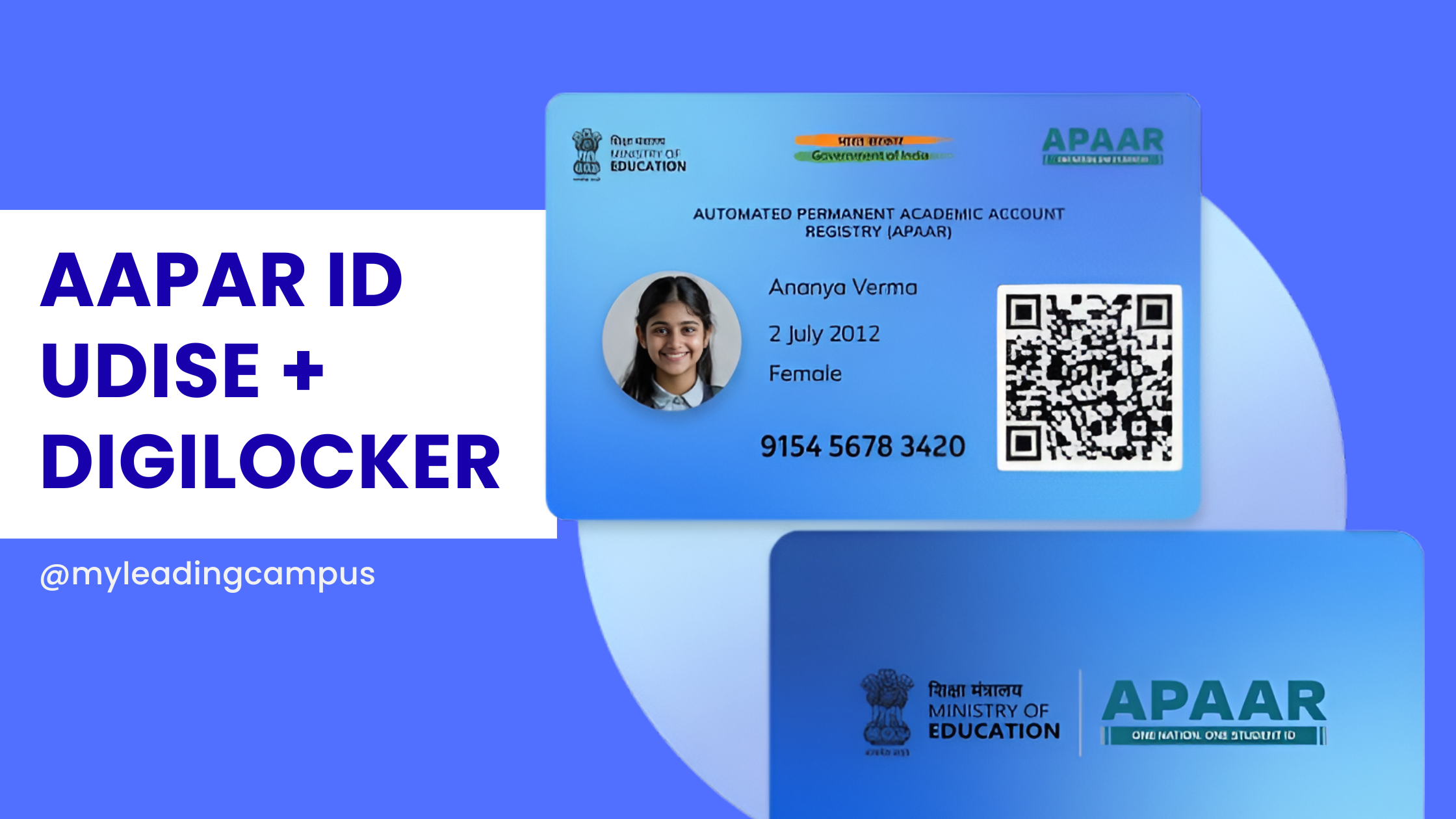
What is APAAR ID? The Real, No-Nonsense Guide for Schools in 2026 Let's be completely honest for a second: running a school right now is starting to feel a whole lot like running a government data entry center. I was chatting with a bunch of school owners recently at the School Summit in Chandigarh, and almost everyone was stressing over the exact same thing. The APAAR ID mandate. If you are a principal or an administrator navigating 2026, you already know the education department is pushing this hard. But what exactly is it, and how on earth are you supposed to manage it without your admin staff quitting out of sheer frustration? What is APAAR ID, Anyway? Think of it as an Aadhaar card, but strictly for academics. APAAR gives every single student a unique 12-digit lifelong ID number. This number ties directly into the Academic Bank of Credits (ABC). So, whether a kid switches to a new school in a different state, wins a recognized sports tournament, or eventually finishes 12th grade, all that data gets securely locked into their personal digital vault. It's actually a fantastic concept for the students, eliminating the need for physical mark sheets and transfer certificates. But for schools? It is a massive logistical headache. The Hidden Challenge: The UDISE Connection A lot of guides skip over how this actually works in practice. You can't just invent an APAAR ID. The system relies on a very specific chain of verified data: School Data → UDISE Verification → APAAR ID Generation → DigiLocker Storage If your UDISE records are outdated, or if a student's name in your register doesn't perfectly match their Aadhaar card, the whole chain breaks. The government portal simply kicks back an error. The Real Numbers: Manual vs. Automated Let's say you have a school with 1,000 students. If you try to manage the UDISE matching, parental consent, and APAAR generation manually by having staff type into government portals, you are looking at: 30–40% error rates due to data mismatches. Weeks of delays chasing down lost paper consent forms. Constant timeouts because the national portals get overwhelmed. This is exactly why we spent so much time building our APAAR ID software for schools. We wanted to flip those numbers. How MyLeading Campus Actually Fixes It Instead of wrestling with messy Excel sheets, our ERP is fully DigiLocker integrated and compatible. We actually set up a dedicated partner account with DigiLocker just to make sure this API connection is rock solid for our partner schools. We built a centralized dashboard just for school principals. You open it up in the morning, and right there you can see the big picture. You know exactly how many IDs are successfully generated, which classes still need parental consent, and which specific Aadhaar/UDISE names are throwing errors so your team can fix them fast. The software handles the hardest part: the parents. It pushes digital consent requests straight to the parents' smartphones. Once they approve it with a quick OTP, you just select the class and click a button to generate the IDs in bulk. No more typing things one by one. Want to implement APAAR without the stress? Stop paying your staff to do manual data entry. Book a free demo today and I will personally walk you through the exact workflow of our school ERP to show you how easy compliance can be. Quick FAQs 1. Is the APAAR ID actually mandatory for my school? Yes. The Ministry of Education requires it for tracking academic progress and managing the ABC. It is becoming the backbone of student identity in India. 2. Can we generate the ID without UDISE data? No. The government requires verified UDISE data as the foundation before an APAAR ID can be legally generated. 3. What is the role of DigiLocker here? DigiLocker is the actual vault. While APAAR is the ID number, DigiLocker is where the mark sheets and certificates are securely stored and verified. 4. Do we have to use the government website directly? You can, but it is painfully slow for bulk entries. Using a DigiLocker-integrated partner system like MyLeading Campus bypasses the manual data entry and lets you do everything from one screen.
Holistic Progress Report Card (NEP 2020): Format, Examples, Challenges & How Schools Can Actually Implement It: Guide for Schools 2026
  • 2026-03-23
  • Admin

Holistic Progress Report Card (NEP 2020): Format, Examples, Challenges & How Schools Can Actually Implement It: Guide for Schools 2026

Holistic Progress Report Card (NEP 2020): Format, Examples & Implementation Guide 2026 If you're a school leader or administrator, you've likely heard about the Holistic Progress Report Card (HPC) under NEP 2020. On paper, it sounds simple — focus on skills, not just marks. But in reality, most schools are struggling with implementation. This guide focuses on one thing: how to actually implement HPC without increasing workload. --- What is a Holistic Progress Report Card? A Holistic Progress Report Card (HPC) is a system introduced under NEP 2020 to evaluate a student’s complete development. Academic performance Skill-based learning Behavioral traits Social and emotional growth Unlike traditional report cards, HPC focuses on continuous development, not just exam results. Traditional vs Holistic Report Card Aspect Traditional Holistic Focus Marks Overall Development Evaluation Exam-based Continuous Skills Tracking No Yes Feedback Limited Detailed --- Why Schools Are Struggling No standard format available Too many evaluation parameters High time consumption Teacher resistance due to workload Lack of proper tools Understanding HPC is easy. Implementing it manually is the real challenge. --- Holistic Progress Report Card Format A practical HPC should include: Student Information Academic Evaluation Skill Assessment Co-curricular Activities Behavioral Observations Teacher Remarks 👉 Explore a complete ready-to-use structure here: Holistic Progress Card Full Solution --- Real Challenge: Time Creating one report manually takes ~20 minutes. For 1000 students = 300+ hours of work. This is why schools are moving toward automation. --- Try Live HPC Builder Instead of imagining, try generating a real report: 👉 Try Free Live HPC Builder --- How Schools Are Solving This Manual Method Excel sheets Word templates Copy-paste remarks Result: Errors, delays, frustration Automated Method Pre-built formats Auto remarks One-click generation Result: Speed, accuracy, consistency --- Benefits of Holistic Progress Cards Better student insights Improved parent communication Reduced teacher workload Future-ready system --- Explore Detailed Guide For a deeper understanding, read our complete guide: 👉 Complete HPC Guide for Schools 2026 --- FAQs (Highly Important) 1. What is a Holistic Progress Report Card? It is a NEP 2020-based report system that evaluates academic, behavioral, and skill-based development of students instead of just marks. 2. Is HPC mandatory for schools? While full implementation is evolving, schools are expected to align with NEP 2020 guidelines, making HPC increasingly essential. 3. How can schools create HPC easily? Manual creation is time-consuming. Schools are adopting automated systems to generate reports quickly and accurately. 4. What is included in an HPC? It includes academics, skills, co-curricular activities, behavior, and teacher remarks. 5. How much time does it take to generate one report? Manually: 15–30 minutesAutomated: Less than 2 minutes 6. Can HPC be customized? Yes, formats can be customized based on school or board requirements. 7. Why is HPC important? It provides a complete picture of a student's growth, helping teachers and parents make better decisions. 8. Is there any software for HPC? Yes, modern ERP systems now offer automated HPC generation aligned with NEP 2020. --- Final Thought HPC is not just a new format. It’s a shift in how education evaluates students. The real question is: Do you want teachers spending hours creating reports… or minutes generating them? 👉 Try Live Builder👉 Explore Full Solution
Chat with us on WhatsApp